Saturday, February 12, 2011

Nina Beier and Marie Lund

"London-based Danish artist Marie Lund and Berlin-based Nina Beier work individually but have maintained a collaborative practice since 2003. With staged events as well as videos, photographs and sculptures, Beier and Lund tinker with social hierarchies and group dynamics. Together they have created performances, objects, and ethereal interventions, often rooted in the history of materials, context, and social space. Exploring the conditions of conception, perception, and interpretation, Beier and Lund test the boundaries of communication while introducing subtle shifts within institutional and behavioral structures."


Nina Beier Marie Lund
"A sensed perturbation" 2008

Nina Beier Marie Lund
"The Home and the Backdoor"

Monday, January 24, 2011

Remember Then: An Exhibition on the Photography of Memory

I am pleased to announce the inclusion of my photographs in the upcoming exhibition “Remember Then: An Exhibition on the Photography of Memory” being held at Concourse Gallery at Harvard University and co-curated by Regina Mamou and Scott Patrick Wiener.

“Remember Then: An Exhibition on the Photography of Memory is based on a simple premise that photographs are used as tools by our culture to recall the past. The artists in Remember Then set out to interrogate this proposition, and memories are used as source material for recreating images in the present, systematically and through various methodologies. How a viewer understands and receives this new memory is the catalyst for each image.”
(For the full press release please follow the link.)

It is truly an honor to be featured along side such extremely talented artist.
Jesse Avina
Carrick Bell
Wafaa Bilal
Kevin Buzzell
Helen Maurene Cooper
Jill Frank
Eiko Grimberg
Sharon Harper
Julia Hechtman
David Hilliard
Chelsea Knight
John Merrill
Daniel Poller
Arne Reimer
Irina Rozovsky
Michael Ruglio-Misurell
Jayanti Seiler
Kurt von Stetten
Nicole White

Concourse Gallery
CGIS Harvard University
1739 Cambridge Street
Cambridge MA, 02138

Opening: February 3rd 6-9pm


Tuesday, January 4, 2011

Stan Douglas - Television Spots/Monodramas

A few years back I had the opportunity to see Stan Douglas's Monodramas at the Guggenheim in New York. At the time I was studying photography at the School of Visual Arts, my Junior year, and was working on a photographic project entitled Story Telling. I know, very original and unique right. It was a project in which I was plumbing the possibility for photographs to be structured as ambiguous open ended narratives that would invite viewer interaction/interpretation. Initially what drew my interest to Douglas's Monodramas was biased. I neglected to understand the conceptual complexity of Douglas's work and instead focused on his process of creating ambiguous narratives open for interpretation. How ever Douglas's work is far more complex than creating simple dramas.

Stan Douglas_Monodrama_1991_"Don't Call Me Gary"
Douglas's Television Spots/Monodramas were made at the hight of post modern art practice. The short videos explore the hallmark trope that many artist were plumping in their work, namely the minutiae of everyday life. Douglas particular aesthetic, especially in the Monodramas, reflects the slick advertising technique found in the late 80's early 90's commercials.  Unlike the average television ad the video pieces do not include those devices that anchor something specific and concrete. Namely narrator, text, product placement, narrative. These devices which normally help the viewer interpret the message, what to buy, etc, are absent.  As the viewer of  Television Spots/Monodramas we are set into the middle of an ambiguous setting without the narrative safety of beginning middle or end. We are left to interpret the video for what it is, and subsequently what it is not.


Douglas's process reveals the empty shell of advertising through these absences while critiquing the function/spectacle/promise of advertising. In one of the Monodramas, personally the one I enjoy the most, the viewer is presented with three scenes involving a car. Instead of a car commercial presenting the viewer with the romantic trappings of travel on the open road,  the promise of status and happiness, Douglas's  commercial presents the everyday mundane reality that surrounds the culture of the automobile. Cars break down, cars drive on the highway in daily exercises of commuting, and every grand adventure in a car usually ends in the same non desrcript parking spot.


You can view a larger resolution below at Ubuweb's Stan Douglas site.

Monday, November 15, 2010

latest update

It has been slow going on the blogging front due to teaching two courses this semester. I am always amazed at just how much time teaching and all its prep work takes out of a day. How ever with the end of my courses approaching it has brought a bit more free time to look at other artist and their work.

Currently I am thoroughly enjoying the photographic works of Emma Wieslander. In "Looking at the Sun" I was struck by the simplicity and minimal quality of the work and it conceptual richness. Wieslander's work operates on a metaphysical level inviting contemplation of the act of photographing the sun and the significance of such an act as performance. The artist choice in using text is similar to Taryn Simons photographic project "An American Index of the Hidden and the Familiar". Both have successfully utilized text in a way that compliments, or anchors as Simon states, the content of their photographs away from ambiguity or absurd.

Monday, August 16, 2010

Off to the Woods

Heading out to the ACRE residency in Wisconsin today. Very much looking forward to eleven days of meeting new people, creating new work, and getting away from the smelly city.


Monday, August 2, 2010

The Documentation of "If Nature Could Talk"

For those who did not get a chance to make it to the event/exhibition of If Nature Could Talk. Installation, details, and photographs follows. Click on images for larger views. 

119 N. Peoria St.
3D
Chicago, IL


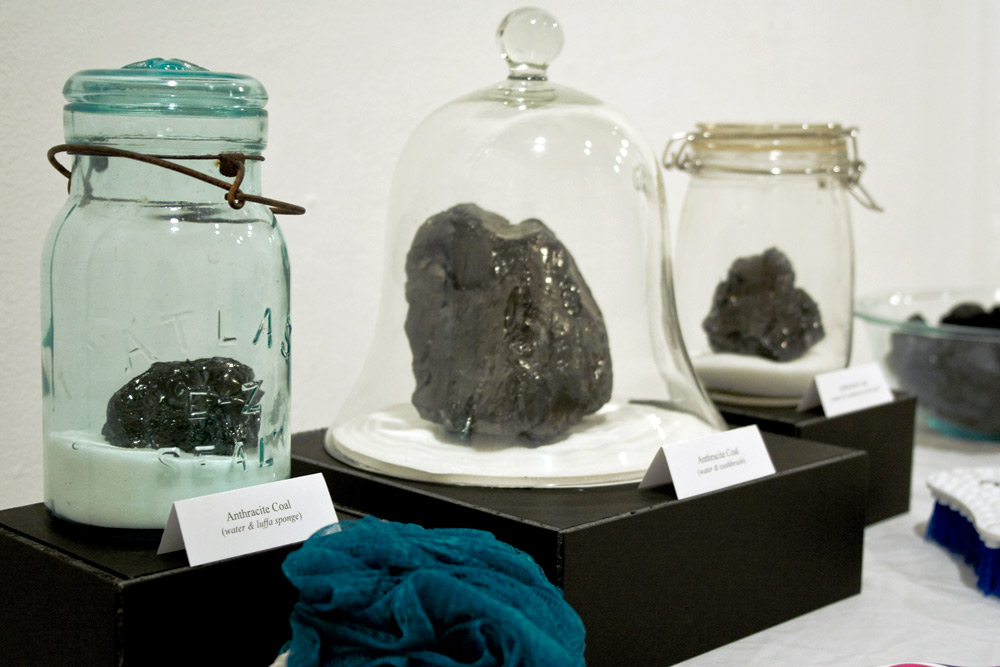
Bridgewater, New Hampshire: Dr. Kerry Nixon, Clean Coal Technology


Dr. Kerry Nixon’s invention introduces the cheap and effective means for everyday individuals to produce their own clean coal. Presented will be three samples of Nixon’s various means in producing clean coal. Coinciding with the presentation visitors will have the opportunity to try the simple means of Nixon’s clean coal invention. Accompanying the three samples visitors are invited to participate and experience the easy to use means of producing clean coal. 


Austin, Texas: Ronald Johnson, Talking Plants


Ronald Johnson invention is a plant translator designed to transmit electrical impulses of plant life into electrical signals. These signals are then translated into corresponding words. Viewers will get a chance to listen in on three separate plants internal dialog.


 Ozark, Missouri: Jeanette Ambs, Fortune Tree


Jeanette Ambs invention introduces what could only be called a fortune tree. The tree was designed in Ambs Fenton based greenhouse through painstaking grafting techniques and splicing of several RNA strands from various trees. The unique tree is designed to bud on the full moon of every month producing several bulbs containing what Ambs states resemble small typed messages. The messages are usually composed of only a few words with content that resembles the tiny messages one finds in fortune cookies. Visitors will have the opportunity to pluck the uncanny fruit from the fortune tree.


Prescott, New Mexico: Abitha Simon, Seed Bomb


Abitha Simon’s invention uses mold, seed bombs, and grass to decipher what plants want to tell us. Simon’s starts with a grafting process that introduces classic literary works with either mold or seeds. After weeks of cultivation the texts are removed from the greenhouse and screened for those parts of the page that remain free of plant or microbial life. With a simple manner of deduction what letters and words are left untouched are the subtle communications of a plant life “natural” communication.


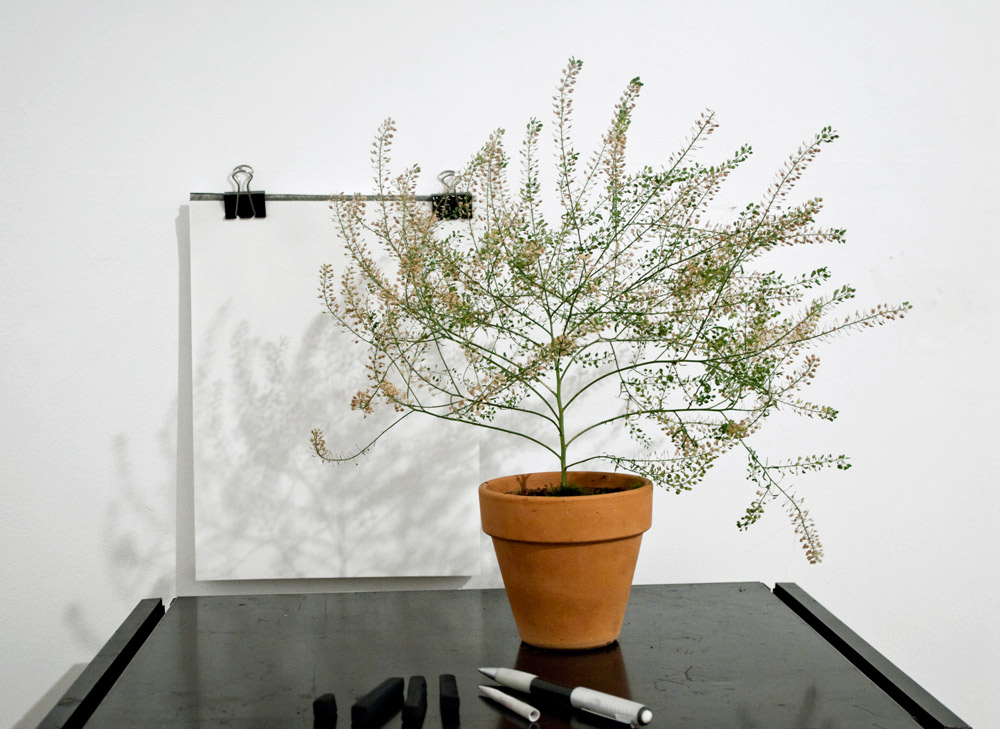
Pevely, Missouri: Denise Brooks, Natural Symbolism


Denise Brook’s invention couples psychologist Hermann Rorschach inkblot experiments, and three unique sources of light to deduce the characteristics or thought patterns of nature. A simple device projects light onto the plant casting its shadow onto a piece of paper. The user traces the shadow resulting in a kind of drawn shadowgram. Visitors will be allowed to project one of three light sources (tungsten, fluorescent, daylight balanced) towards a plant and trace the resulting shadow. 

Tuesday, July 13, 2010

If Nature Could Talk

I am pleased to announce an upcoming exhibition at Spoke gallery titled, If Nature Could Talk. The three-night event will feature photographs that document five new pseudo scientific inventions. Visitors are invited to come and encouraged to interact with the objects and their uncanny results.

“If Nature Could Talk,” is an interactive event that explores the uncanny relationship between art, science, and nature. Based on the investigation of Human/Nature dynamics through marks, traces and symbols of pseudo- scientific experiments, the work suggests what nature might be thinking and feeling in an evidentiary context. Chicago based artist, Grant W. Ray has photographed these strange attempts at communicating with nature. He will be presenting this historic archive and five extraordinary inventions for two nights only at Spoke Gallery. Participants will be invited to interact with ordinary objects that have extraordinary functions such as, “Ronald Johnson’s Talking Plants,” which reportedly translates the thoughts of domesticated houseplants into a language you can understand.

Spoke
119 Peoria
3D
Chicago, IL 60607

Opening Reception: July 23rd 6pm - 9pm
Open hours July 24th, 25th 10am - 6pm